
By DEVI SHASTRI and MARY CONLON Associated Press
More people are focusing on their gut health, as fibermaxxing goes mainstream, colorectal cancer rises among young adults and personalized gut microbiome treatments become increasingly popular.
Now, a generation- and culture-spanning way of preserving food is in the spotlight: fermentation. The federal government’s latest dietary guidelines specifically encourage Americans to eat more fermented food.
The foods have been further popularized by followers of Health Secretary Robert F. Kennedy Jr.’s Make America Healthy Again movement. And while other diet fads championed by MAHA have been questioned by health experts — like unproven claims about raw milk and seed oils — there’s some science behind the benefits of eating fermented foods.
Fermented foods go back thousands of years in human history, to the days when we needed to keep food from spoiling but didn’t have refrigerators. Many cultures have traditional fermented foods: yogurt, kimchi, sauerkraut, South Indian idli and dosa.
Dietitians and doctors say they’re a great addition to almost anyone’s diet, but they warn against new, mass-produced products.
Here’s what to know.
Not all fermented foods are made equal
Fermentation is a process by which naturally occurring microbes including bacteria and yeast break down and preserve food.
The foods are a hot research topic, though many of their health benefits are already clear, experts say.
“We’ve been doing this for ages and we just found out more recently that it’s actually helped our gut health,” said Dr. Lisa Ganjhu, a gastroenterologist with New York University Langone Health.
Still, it doesn’t automatically mean something is healthy if it’s fermented.
“Beer and wine are fermented foods, but they’re not necessarily probiotics,” she said. “If anything, they influence our own microbiome in more of a negative way.”
Barbara Olendzki, director the University of Massachusetts Chan Medical School’s Center for Applied Nutrition, said she recommends people focus on “whole fermented foods” like fermented beets or green beans in addition to foods like yogurt, kefir, kimchi, sauerkraut and tempeh.
Fermented foods feed the gut in two main ways
The microbes in fermented foods help predigest it, breaking it down and changing the compounds available in it. The bacteria themselves also help keep the gut in balance, by competing with other bacteria — some of them less beneficial — already in your intestines.
“What is it that makes the fermented foods so healthy? The answer is we’re still working on it,” said Dalia Perelman, a Stanford University research dietitian.
Some fermented foods, like yogurt, give you the live probiotics while you’re eating them. Others, like sourdough bread, give you few, if any, because they’ve been baked or otherwise processed in ways that kill the microbes. But there’s evidence that some fermented foods are beneficial even without the live microbes, Perelman said.
Beware of marketing hype
Experts warn against sodas, chocolate or other processed foods that market themselves as probiotic. Even probiotic supplements are essentially trying to replicate the combinations of beneficial bacteria that naturally grow in many fermented foods, Perelman said.
“Consumers are getting excited about it and trying to choose products that are fermented and with the idea that it’s very ‘gut healthy,’ which is not a clinical definition,” she said. “And then the marketing is running with this trend.”
Avoid sugary items, too, Ganjhu said. Extra sugar feeds negative bacteria as opposed to the positive bacteria in fermented foods, she said.
And look for items that say “live cultures,” not just that they’re probiotic.
“The best yogurt you can have is just plain, fermented milk with culture,” she said. “Let it do its business.”
Can fermented foods be risky?
While the category of fermented foods is broad, experts say they’re generally safe for most people. And not just for health reasons — they also add interesting and diverse flavors to your plate.
Perelman said people who have weakened immune systems and those with irritable bowl disease may want to talk to their doctors before incorporating the foods into their diet. Some people could experience different reactions depending on which type of fermented food they’re eating.
Olendzki said some people might experience bloating, gas and other discomfort when introducing more fermented foods, especially as their gut adjusts.
“If you feel good, keep drinking it. You don’t feel good? Stop,” Ganjhu said. She noted that the same foods affect people differently.
Eat a diverse mix of fermented foods consistently
So which fermented food is the best? You’ll be hard-pressed to find a scientifically backed ranking that puts sauerkraut over kimchi, or tells you to eat a bowl of yogurt and call it a day.
The best way to eat fermented foods is to eat lots of different kinds, and to make them a regular part of your diet, experts say.
Ganjhu recommended thinking about the foods in categories, like milk-based yogurt and kefir, and fiber-based ones such as kimchi and sauerkraut.
Researchers are also still exploring if it matters how much fermented foods people eat. Just like so many things with diet, the answer is likely very different person to person, experts said.
“We can hedge our bets and just get a variety,” Perelman said. She suggested aiming for two servings a day.
And the foods should be one part of a well-rounded diet, so the good bacteria you’re introducing to your gut have things they like to eat, like fibrous prebiotics. They feed the probiotics, which are the live bacteria themselves.
“Just go slow and drink a lot of water. It also matters what the rest of the diet looks like,” Olendzki said. “It’s not just one thing.”
___
The Associated Press Health and Science Department receives support from the Howard Hughes Medical Institute’s Department of Science Education and the Robert Wood Johnson Foundation. The AP is solely responsible for all content.
News
People have been fermenting food for millennia. Here’s why more people are focused on gut health now
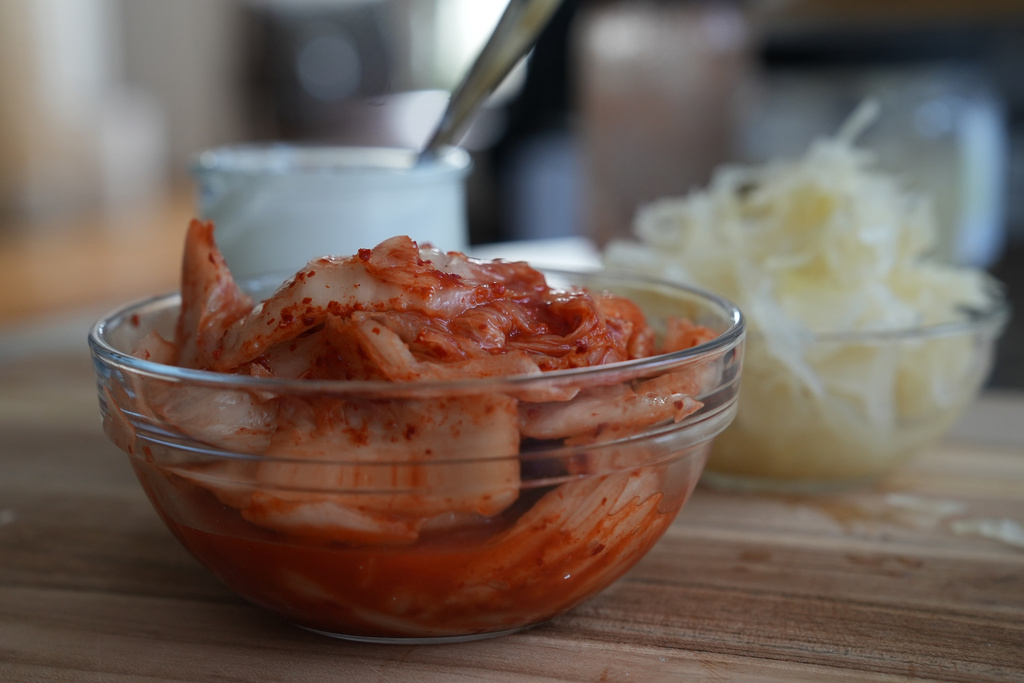
Kimchi, sauerkraut and yogurt are displayed on a kitchen table in New York on July 10, 2026. (AP Photo/Mary Conlon) Photo: Associated Press